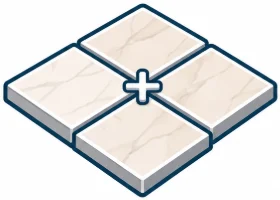
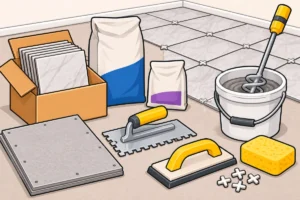
Porcelain is a type of ceramic tile. What makes it porcelain is a test, not a name: under the US standard ANSI A137.1, a tile is porcelain only if it absorbs 0.5% of its weight in water or less when tested to ASTM C373. That density makes porcelain tougher, more water-resistant and more suitable for outdoor use, but also heavier and harder to cut. Non-porcelain ceramic tile absorbs more water, is easier to cut and works well for walls and most indoor floors.
Whichever you choose, the tile calculator gives the number of tiles and boxes, including waste for your layout.
Porcelain vs ceramic at a glance
| Porcelain tile | Ceramic (non-porcelain) tile | |
|---|---|---|
| Water absorption | 0.5% or less (ANSI A137.1) | Above 0.5%; wall tile can be above 7% |
| Body | Dense; through-body porcelain has the same color throughout | Softer body under a glaze, often a different color |
| Typical wear rating | Many are PEI 4 or 5 (glazed) | Often PEI 0 to 3 |
| Floors | All residential floors, including entries and kitchens | Check PEI rating; class 3 or higher for normal floors |
| Showers and wet areas | Well suited | Fine on walls; for floors choose a rating made for floors |
| Outdoors, freezing climates | Can be suitable if rated frost resistant | Usually not suitable |
| Cutting | Harder; needs a good cutter or wet saw | Easier to score and snap |
| Weight | Heavier for the same size | Lighter |
Water absorption classes
Tile is grouped by how much water it absorbs. Lower absorption means a denser tile that stands up better to moisture and freezing.
| Class | Water absorption | Typical use |
|---|---|---|
| Impervious (porcelain) | 0.5% or less | Floors, wet areas, outdoors where rated |
| Vitreous | Over 0.5% to 3% | Floors and some exterior uses |
| Semi-vitreous | Over 3% to 7% | Indoor floors and walls |
| Non-vitreous | Over 7% | Indoor walls |
For patios and other outdoor tile in freezing climates, frost resistance requires vitreous or impervious tile. Even then, no tile is freeze-proof: the tile must be rated for freeze-thaw use (tested to ASTM C1026) and installed so water drains away.
PEI ratings: how hard-wearing is the glaze?
| PEI class | Suitable for |
|---|---|
| 1 | Walls only |
| 2 | Walls and bathroom floors |
| 3 | Walls, countertops and floors with normal foot traffic |
| 4 | All residential use, plus medium commercial |
| 5 | All residential use, plus heavy commercial |
PEI and porcelain answer different questions. Water absorption says how dense the body is; PEI says how well the glazed surface resists wear. A ceramic tile can have a good PEI rating, and a porcelain wall tile can have a low one, so check both for floors.
Which should you choose?
- Bathroom and kitchen walls, backsplashes: either. Ceramic is easier to cut around outlets and fixtures.
- Bathroom floors and showers: porcelain, or ceramic rated for floors (PEI 2 or higher for bathrooms, 3 or higher for busier rooms).
- Kitchens, entries, hallways: porcelain or ceramic with PEI 3 or higher.
- Outdoors and unheated spaces in cold climates: porcelain rated frost resistant.
- DIY on a budget: ceramic is lighter and easier to cut, which helps if you do not own a wet saw.
Installing porcelain
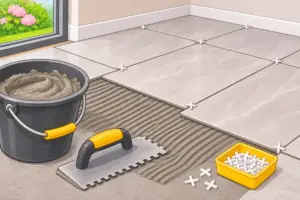
Because porcelain absorbs so little, the setting mortar has to grip a very dense surface. Use a thin-set mortar whose bag says it is suitable for porcelain tile, and follow its trowel size for your tile size. The thinset calculator and grout calculator give the number of bags, and tile layout patterns and waste explains how much extra to buy.
Frequently asked questions
How can I tell porcelain from ceramic?
Check the box or spec sheet for water absorption of 0.5% or less, or a porcelain certification mark. Looking at a chipped edge helps with through-body porcelain, but glazed porcelain can also have a different-colored body.
Is porcelain always better?
Not always. It is better where water, wear or freezing matter. On walls, ceramic does the job, costs less to install and is easier to work with.
Is porcelain more expensive?
Prices overlap widely by product, size and finish. Compare specific tiles, and add the cost of a wet saw rental and porcelain-rated mortar to the porcelain option. The project cost calculator adds up the materials for each choice.
Sources
- ANSI Blog: Porcelain and Ceramic Tile, ANSI A137.1 and ASTM definitions (porcelain defined as 0.5% water absorption or less)
- ASTM Standardization News: Standards and the Ceramic Tile Industry (2024) (porcelain certification and test methods)
- The Home Depot: Understanding Tile Project Guide (PDF) (water absorption classes, frost resistance, PEI ratings)
- NKBA: Choosing the Right Tile (Angela Miller, Dal-Tile, 2012) (PEI classes and porcelain vs ceramic)