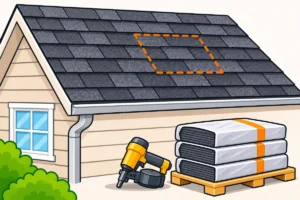
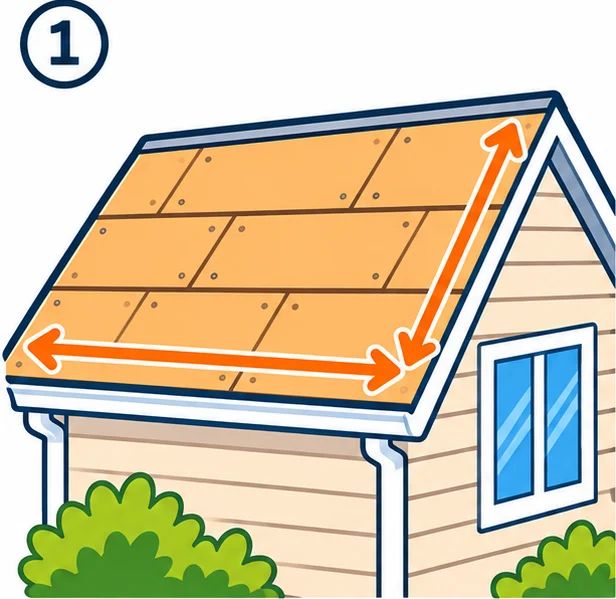
Enter the length and width of the house measured to the drip edge, then pick the roof pitch and shape. The calculator turns the flat footprint into the real sloped roof area and counts the squares, shingle bundles and underlayment rolls to order.
How the roofing calculator works
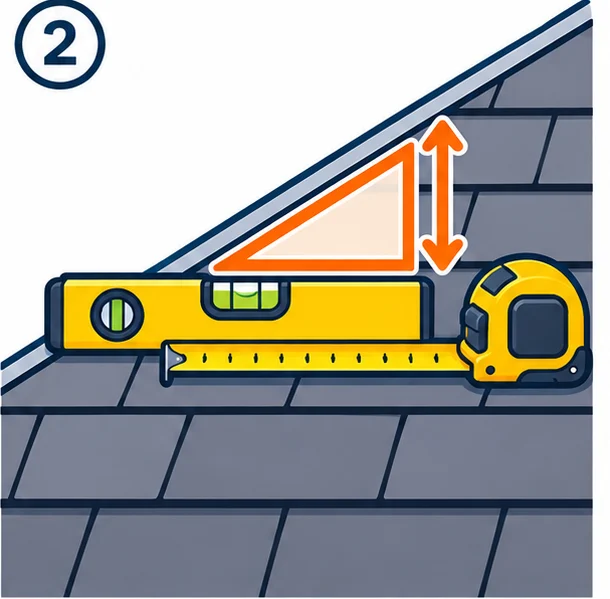
- Pitch factor = √(1 + (rise ÷ 12)²). A 6/12 roof rises 6 in for every 12 in across, so its factor is 1.118.
- Roof area = footprint length × width × pitch factor. Measure the footprint including overhangs.
- Squares = roof area ÷ 100 sq ft. Roofers price and order by the square.
- Bundles = squares × 3 bundles per square, plus waste (10% for a gable roof, 15% for a hip roof), rounded up.
- Underlayment rolls = roof area plus waste ÷ the area one roll covers after its laps, rounded up.
For a roof with one pitch, every plane has the same factor, so the footprint method works for both gable and hip roofs. Hip roofs need more cutting, which is why the default waste is higher.
Worked example
A gable roof over a 40 × 30 ft footprint (overhangs included) has a 6/12 pitch. 1,200 sq ft × 1.118 = 1,342 sq ft of roof, or 13.42 squares. 13.42 × 3 = 40.2 bundles, and 10% waste makes 45 bundles. The same house with a hip roof and 15% waste needs 47 bundles. For underlayment, 1,342 sq ft plus 10% is 1,476 sq ft: 2 rolls of 48 in × 250 ft synthetic, or 4 rolls of No. 15 felt.
Pitch factor and bundles per 1,000 sq ft of footprint
| Pitch | Pitch factor | Roof area | Bundles, gable (10%) | Bundles, hip (15%) |
|---|---|---|---|---|
| 3/12 | 1.031 | 1,031 sq ft | 35 | 36 |
| 4/12 | 1.054 | 1,054 sq ft | 35 | 37 |
| 5/12 | 1.083 | 1,083 sq ft | 36 | 38 |
| 6/12 | 1.118 | 1,118 sq ft | 37 | 39 |
| 8/12 | 1.202 | 1,202 sq ft | 40 | 42 |
| 10/12 | 1.302 | 1,302 sq ft | 43 | 45 |
| 12/12 | 1.414 | 1,414 sq ft | 47 | 49 |
How many rolls of underlayment?
Rolls are sold by their full size, but each course overlaps the one below and the ends of rolls overlap too, so a roll covers less than its label. On slopes from 2/12 up to 4/12 the underlayment must be laid in two layers, which roughly halves what each roll covers.
| Underlayment | Roll size | Laps used | Covers, 4/12 and steeper | Covers, 2/12 to under 4/12 |
|---|---|---|---|---|
| Synthetic (GAF FeltBuster) | 48 in × 250 ft (1,000 sq ft) | 3 in side, 6 in end | 936 sq ft | 468 sq ft |
| No. 15 asphalt felt | 36 in × 144 ft (432 sq ft) | 2 in side, 4 in end | 407 sq ft | 203 sq ft |
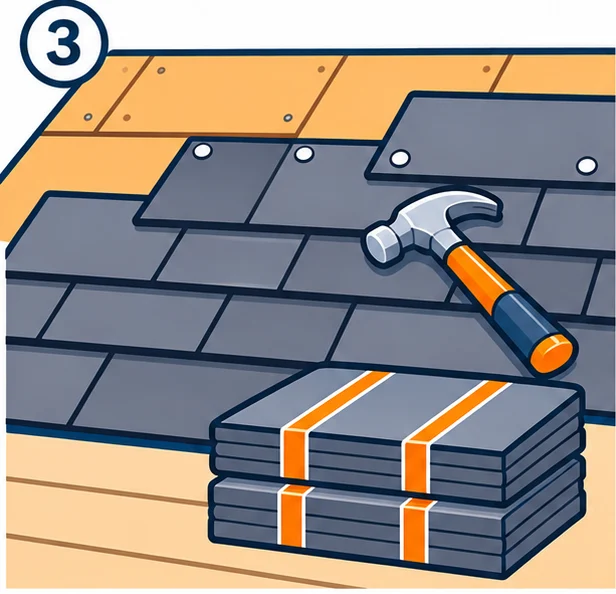
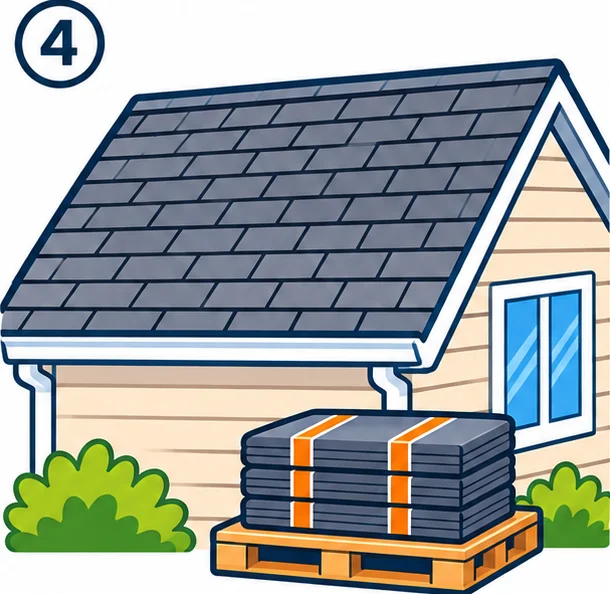
Step by step: estimating shingles
Tips before you order
- Most 3-tab and architectural shingles come 3 bundles to a square, but some heavy designer shingles need 4 or 5. Check the wrapper.
- Starter strip, ridge and hip cap, drip edge, flashing and any ice barrier at the eaves are ordered separately.
- Dormers, valleys and skylights add cutting. Raise the waste for complex roofs.
- Working on a roof is dangerous. Use fall protection, or measure from the ground and from plans.