Enter the size of the floor or wall and the trowel notch you will use. The calculator adds extra for mixing loss and uneven substrate, then divides by how far one 50 lb bag goes with that notch and rounds up to whole bags.
How the thinset calculator works
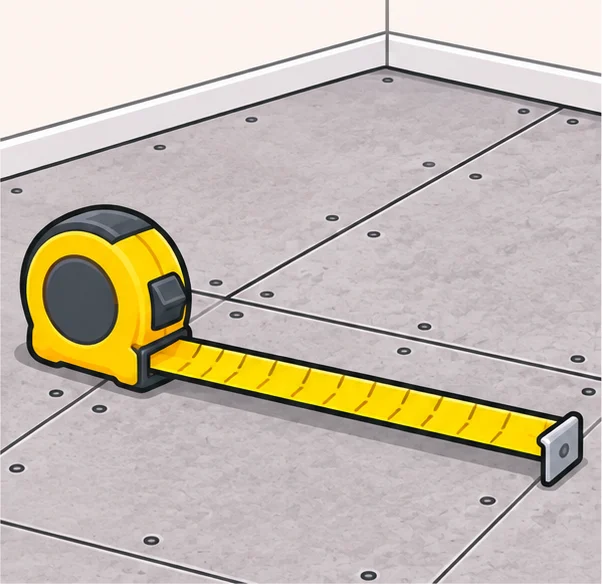
- Area = length × width, plus the extra percentage.
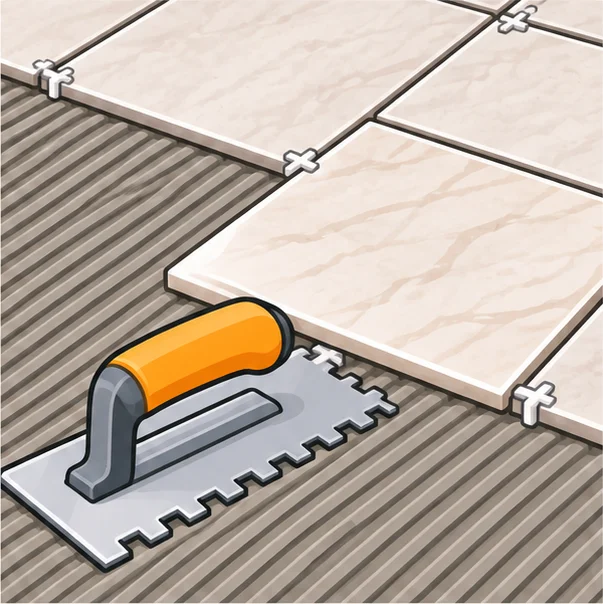
- Coverage per bag depends on the trowel notch: a bigger notch leaves thicker ridges of mortar, so a bag covers less floor.
- Bags = area ÷ coverage per bag, rounded up. The count uses the low end of the published coverage range so you are less likely to run short; the high end is shown as a best case.
The coverage figures are the published ranges for one widely sold mortar, Custom Building Products VersaBond, for a 50 lb bag. Other mortars, especially large-format and lightweight mortars, cover a different area, so check the chart on your bag.
Coverage per 50 lb bag by trowel notch
| Trowel notch | Coverage per 50 lb bag |
|---|---|
| 1/4 × 1/4 × 1/4 in square notch | 90 to 100 sq ft |
| 1/4 × 3/8 × 1/4 in square notch | 60 to 67 sq ft |
| 3/4 × 9/16 × 3/8 in U-notch, held at 30° | 42 to 47 sq ft |
| 3/4 × 9/16 × 3/8 in U-notch, held at 45° | 34 to 38 sq ft |
Worked example
A 10 × 12 ft bathroom floor is 120 sq ft. With 10% extra that is 132 sq ft. Using a 1/4 × 1/4 in square-notch trowel, one bag covers 90 to 100 sq ft, so 132 ÷ 90 = 1.47 bags. Buy 2 bags. With the 1/4 × 3/8 in notch often used for larger tile, 132 ÷ 60 = 2.2, so 3 bags.
Bags for common floor sizes
| Floor area | 1/4 × 1/4 in | 1/4 × 3/8 in | 3/4 U-notch, 30° | 3/4 U-notch, 45° |
|---|---|---|---|---|
| 50 sq ft | 1 | 1 | 2 | 2 |
| 100 sq ft | 2 | 2 | 3 | 4 |
| 200 sq ft | 3 | 4 | 6 | 7 |
| 400 sq ft | 5 | 8 | 11 | 13 |
Choosing the trowel
- Larger tiles usually need a larger notch so the mortar fills the space under the whole tile. The tile and mortar instructions give the trowel size to use.
- Check coverage while you work: lift a freshly set tile now and then and look at how much of its back is covered with mortar.
- Back-buttering large or warped tiles uses extra mortar. Add to the extra percentage if you plan to do it.
Step by step: estimating and buying thin-set

Tips before you buy
- Unopened bags keep for a while if stored dry; check the shelf life on the bag before buying extra.
- Use the mortar type the tile maker recommends, especially for large-format, natural stone and glass tile.
- The tile calculator counts tiles and boxes, and the grout calculator estimates grout for the same floor.
- See what a tile job needs and costs for the full materials list.