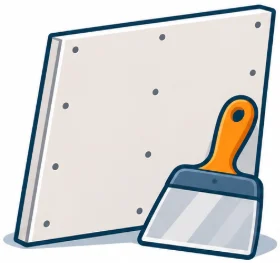
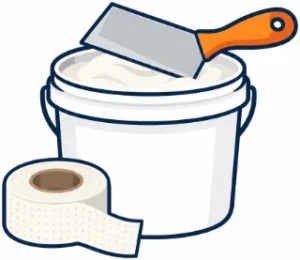
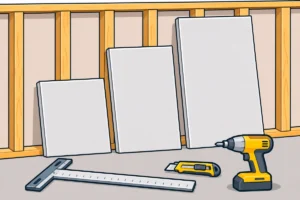
How you repair a hole in drywall depends on its size. Nail holes and small dents only need spackle. Holes up to about 3 to 4 inches, such as a doorknob hole, are covered with a self-adhesive mesh patch and joint compound. Larger holes need a new piece of drywall cut to fit, with wood backing or a repair plate behind it. Each method ends the same way: thin coats, sanding and primer before paint.
Replacing whole sheets instead? The drywall calculator and drywall mud calculator give sheets, compound and tape.
Which repair for which hole?
| Hole | Repair | Materials |
|---|---|---|
| Nail and screw holes, small dents (up to about ½ in) | Spackle, one or two thin layers | Lightweight spackle, putty knife, fine sandpaper |
| Up to about 3 to 4 in (doorknob, anchor pull-out) | Self-adhesive mesh patch covered with joint compound | Patch kit, joint compound, 6 in knife, sanding sponge |
| About 4 to 6 in | Mesh or metal patch, or a “California patch” (drywall piece with its own paper flange) | Drywall scrap, utility knife, compound |
| Larger than about 6 in | Cut out a square, add wood backing, screw in a new piece, tape the seams | Drywall, furring strips or 1×3s, drywall screws, tape, compound |
Small holes: spackle
- Scrape off loose paper and any raised edges with a putty knife.
- Press spackle into the hole and drag the knife across it to leave it flush.
- Let it dry. DAP DryDex takes 1 to 5 hours depending on temperature, humidity and depth, and turns from pink to white when ready; 3M Patch Plus Primer is ready to paint in about 30 minutes for a ½ in hole.
- For anything deeper than about ⅛ in, apply a second layer rather than one thick one.
- Sand lightly, wipe off the dust, prime the spot (unless the product is self-priming) and paint.
Medium holes: mesh patch
- Trim ragged edges and make sure the area around the hole is clean and dry.
- Center a self-adhesive mesh patch over the hole and press it flat. Choose a patch at least an inch larger than the hole on all sides.
- Spread a thin coat of joint compound over the patch, feathering it a few inches past the edges.
- Let it dry. Joint compound can take up to 24 hours per coat; USG allows about 24 hours between coats at 75°F and 50% humidity.
- Apply a second, wider coat, then a third if the mesh still shows. Each coat should be thin.
- Sand smooth with fine paper or a sanding sponge, then prime and paint.
Large holes: cut-in patch
- Draw a square around the damage and cut it out with a drywall saw, checking first for wires and pipes behind the wall.
- Screw wood strips inside the opening, across the top and bottom or along the sides, so the new piece has something to fasten to.
- Cut a piece of drywall of the same thickness to fit the opening and screw it to the backing.
- Tape the seams with paper or mesh tape and joint compound, as for new drywall.
- Apply two or three thin coats, feathering each one wider, and let each dry overnight.
- Sand, prime and paint.
Tips for an invisible repair
- Thin coats sand faster and crack less than one thick coat.
- Feather the edges wide, several inches beyond the patch, so there is no visible bump.
- Hold a work light at a low angle to the wall to spot ridges before priming.
- Prime repaired areas before painting, or the patch can show through as a dull spot (“flashing”).
- Keep the room above 50 to 55°F; spackle and joint compound dry slowly or poorly in the cold.
Frequently asked questions
Spackle or joint compound?
Spackle is best for small holes: it dries fast and shrinks little. Joint compound is better for patches and seams, where you need to cover a larger area in thin, feathered coats.
How long before I can paint?
For spackle, from about 30 minutes to a few hours depending on the product and depth. For joint compound patches, wait until the final coat is completely dry, usually overnight, then prime.
Do I need to prime a patch?
Usually yes, unless the product says it contains primer. See the primer calculator and how long paint takes to dry.
Sources
- 3M Patch Plus Primer (ready to paint in 30 minutes for small holes)
- 3M Wall Repair products (small hole and large hole kits by hole size)
- DAP DryDex Spackling technical data sheet (via Lowe’s) (dry time, layering deeper repairs, temperature)
- USG Sheetrock Patch and Repair Pack instructions (manual copy) (time between coats, tape, sanding)
- The Home Depot: How to Patch and Repair Drywall (spackle, mesh patches and cut-in patches by hole size)
- Lowe’s: How to Patch and Repair Drywall (California patch and backing for larger holes)