Enter the size of the room, the wall height and the number of doors and windows. The calculator works out the drywall area to finish, then estimates the joint compound (mud) and paper tape for taping and two finish coats, rounded up to whole pails and rolls.
How the mud and tape calculator works
- Area = wall perimeter × height, minus doors and windows, plus the ceiling if you include it. It is the same area the drywall calculator uses for sheets.
- Joint compound = area × about 9 gal per 1,000 sq ft, plus the extra percentage, rounded up to whole pails.
- Tape = area × about 370 ft per 1,000 sq ft, plus the extra percentage, rounded up to whole rolls.
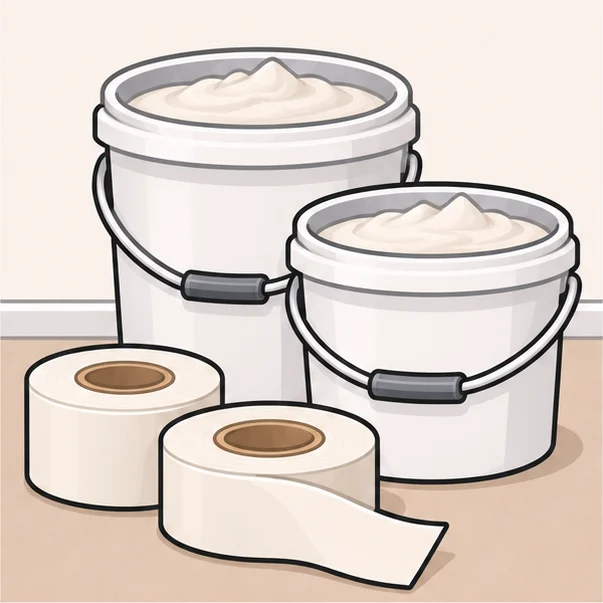
Both rates come from USG, the maker of Sheetrock. USG says about two 4.5 gal pails of its UltraLightweight all-purpose compound finish about 1,000 sq ft of wallboard, and its paper joint tape covers about 370 ft per 1,000 sq ft. Other compounds cover a different area, so check the pail.
Coverage per 1,000 sq ft of drywall
| Material | Amount per 1,000 sq ft | Pack sizes |
|---|---|---|
| Ready-mixed all-purpose joint compound | About 9 gal (two 4.5 gal pails) | 1, 3.5 and 4.5 gal pails |
| Paper joint tape | About 370 ft | 250 ft and 500 ft rolls |
Worked example
A 12 × 12 ft bedroom with 8 ft walls has 384 sq ft of wall. Take off one door (21 sq ft) and one window (15 sq ft) and there is 348 sq ft to finish. With 10% extra, that needs 348 × 9 ÷ 1,000 × 1.1 = 3.4 gal of compound, so one 4.5 gal pail, and 348 × 370 ÷ 1,000 × 1.1 = 142 ft of tape, so one 250 ft roll. Add the 144 sq ft ceiling and it becomes 4.9 gal, or two pails.
Mud and tape for common room sizes
| Room (8 ft walls) | Area to finish | Compound | Tape |
|---|---|---|---|
| 10 × 10 ft, walls only | 284 sq ft | 2.8 gal (1 pail) | 116 ft (1 roll) |
| 10 × 10 ft, with ceiling | 384 sq ft | 3.8 gal (1 pail) | 156 ft (1 roll) |
| 12 × 12 ft, with ceiling | 492 sq ft | 4.9 gal (2 pails) | 200 ft (1 roll) |
| 12 × 16 ft, with ceiling | 589 sq ft | 5.8 gal (2 pails) | 240 ft (1 roll) |
| 14 × 20 ft, with ceiling | 737 sq ft | 7.3 gal (2 pails) | 300 ft (one 500 ft roll) |
Which compound to use
- All-purpose compound works for taping and every coat, which is why one product is used for the estimate.
- Many people tape with all-purpose and use a lighter topping compound for the last coats because it sands more easily.
- Setting-type (powder) compound hardens by a chemical reaction rather than drying, so it is useful for deep fills and quick repairs. It is sold by weight and covers a different area.
- Outside corners get metal or paper-faced corner bead instead of tape; add a little compound for each one.
Step by step: estimating and buying mud and tape
Tips before you buy
- A spare pail is cheap insurance; unopened ready-mixed compound keeps for months if it does not freeze.
- Mesh tape is an alternative to paper on flat seams, but it is usually paired with setting-type compound for the first coat.
- The drywall calculator counts the sheets for the same room, and the paint calculator estimates primer and paint once the walls are finished.
- See drywall sheet sizes for choosing 4×8, 4×10 or 4×12 boards.