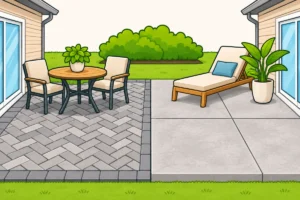
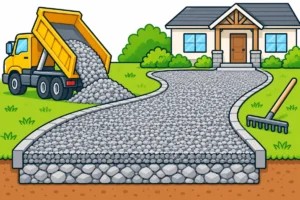
For a patio or walkway, plan on 4 to 6 inches of compacted crushed-stone base under a 1 to 1½ inch layer of bedding sand. A residential driveway needs a thicker base, typically 6 to 8 inches. These are the minimums the Interlocking Concrete Pavement Institute (ICPI) gives for typical soils; soft, wet or clay soils and heavier vehicles call for more.
The paver patio calculator works out the pavers, the base in tons and the bedding sand from your patio size and base depth.
What is a paver base?
Pavers are not glued or set in concrete. They sit on a thin bed of sand, and the sand sits on a thick layer of compacted crushed stone. The base spreads the weight of people or cars over the soil and lets water drain away. Most paver problems, such as sinking, ruts and heaving, come from a base that is too thin or not compacted well, not from the pavers.
Paver base layers explained
| Layer | What it is | Typical thickness |
|---|---|---|
| Pavers | Concrete or clay units, joints filled with sand | ICPI recommends 2⅜ in (60 mm) for walks and residential driveways |
| Bedding sand | Coarse, washed sand screeded flat; not stone dust | 1 to 1½ in, uncompacted |
| Aggregate base | Dense-graded crushed stone, compacted in lifts | 4 to 6 in for walks and patios; 6 to 8 in for residential driveways |
| Subgrade | The existing soil, compacted | Remove topsoil and organic material |
| Edge restraint | Plastic, metal or concrete edge that holds the pavers in | Along every open edge |
How soil and load affect base depth
- Foot traffic only. Patios, walkways and pool decks sit at the lower end, 4 to 6 inches.
- Cars. Driveways carry concentrated wheel loads and turning forces; 6 to 8 inches is the starting point.
- Heavier vehicles. Trucks, RVs and delivery vehicles need a design for the actual load, often with a thicker base.
- Weak or wet soils. Clay and poorly drained soils lose strength when wet. A thicker base, a geotextile under it, or better drainage is common.
- Freezing climates. Frost heave is worse in wet, fine-grained soils; good drainage through the base matters more than extra paver thickness.
How to calculate aggregate and bedding material
- Area. Length × width, in square feet.
- Base volume. Area × base depth in feet. A 4 in base is 4 ÷ 12 = 0.333 ft.
- Convert to cubic yards by dividing by 27, then add about 10% because crushed stone compacts.
- Convert to tons if your supplier sells by weight. Our calculators use 2,800 lb per cubic yard as a typical figure for crushed stone; ask your supplier for the weight of their material.
- Bedding sand. Area × 1 in ÷ 12. In bags of 0.5 cu ft, that is 2 bags per 12 sq ft.
Base and sand for common patio and driveway sizes
| Project | Base depth | Base (cu yd, +10%) | Base (tons) | Sand, 1 in (cu ft) |
|---|---|---|---|---|
| 12 × 12 ft patio | 4 in | 1.96 | 2.7 | 12 (24 bags) |
| 12 × 12 ft patio | 6 in | 2.93 | 4.1 | 12 (24 bags) |
| 10 × 20 ft driveway pad | 6 in | 4.07 | 5.7 | 16.7 (34 bags) |
| 10 × 20 ft driveway pad | 8 in | 5.43 | 7.6 | 16.7 (34 bags) |
Notice how quickly the base adds up: going from a 4 to a 6 inch base on the same patio adds about 1.4 tons of stone. That is still far cheaper than relaying a patio that has sunk. The gravel calculator handles base layers for other shapes.
Compaction and drainage mistakes to avoid
- Compacting the whole base in one go. Spread and compact crushed stone in layers (lifts), typically no more than a few inches at a time, with a plate compactor.
- Using the sand to level the base. The base should be graded to the final slope; the sand layer should be an even thickness, not a filler for low spots.
- Too much sand. A thick sand bed lets pavers shift and rut. Keep it to 1 to 1½ inches.
- No slope. Grade the base so water runs away from the house; the pavers follow the base.
- Skipping edge restraints. Without them, edge pavers spread and the joints open.
- Building on topsoil. Dig out organic soil; it compresses and rots.
Weighing pavers against a poured slab? Our guide to concrete slab thickness covers the concrete side.
Sources
- ICPI Tech Spec 10: Application Guide for Interlocking Concrete Pavements (base, bedding sand and paver thickness)