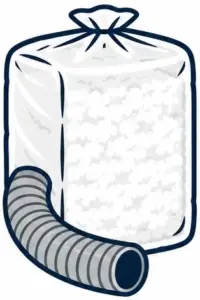
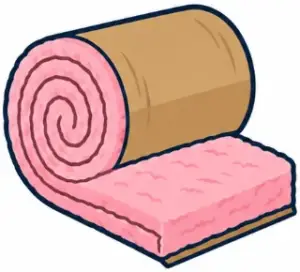
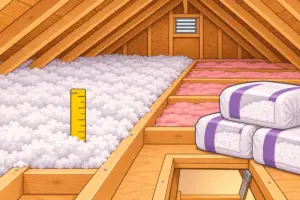
Use batts for open stud walls, floors and ceilings with standard joist spacing, where each cavity can take a pre-cut piece. Use blown-in (loose-fill) insulation for attic floors, especially when there is old insulation to top up, wiring and pipes in the way, or irregular joists, because it fills around obstructions. Both can reach the same R-value; they are bought and measured differently.
Batts are sold by the package, with the square footage of the batts printed on it. Loose fill is sold by the bag, and the bag chart tells you how many bags per 1,000 sq ft give each R-value. Our batt insulation calculator and blown-in insulation calculator use those manufacturer numbers.
Side by side
| Batts | Blown-in (loose fill) | |
|---|---|---|
| Best for | Open stud walls, floors over crawl spaces, ceilings with standard spacing | Attic floors, topping up old insulation, areas with obstructions |
| How it is sold | Packages; pieces and sq ft printed on the package | Bags; the chart gives bags per 1,000 sq ft for each R-value |
| How you count it | Wall area × batt width ÷ stud spacing | Attic area ÷ 1,000 × bags for the R-value |
| Tools | Utility knife, straightedge, stapler | Blowing machine (often lent with a bag purchase), depth rulers |
| Common mistakes | Compressing batts or leaving gaps around wires | Blowing too thin or uneven; covering soffit vents |
A 1,000 sq ft attic at R-19, counted both ways
Batts. Owens Corning R-19 kraft-faced batts, 15 × 93 in, come 8 to a package covering 77.5 sq ft. Between joists 16 in apart a 15 in batt covers 15/16 of the floor, so 1,000 × 15/16 = 938 sq ft of batts, or 938 ÷ 77.5 = 12.1, 13 packages.
Blown-in. The Owens Corning AttiCat chart gives 9 bags of 27.5 lb fiberglass per 1,000 sq ft for R-19, blown 7 in deep, so 9 bags.
The counts are not a cost comparison: package and bag prices vary by store and region. Enter your local prices in each calculator to compare.
Batt sizes for walls
| Wall framing | Batt R-values | Widths |
|---|---|---|
| 2×4 (3½ in deep) | R-11, R-13, R-15 (high density) | 15 in for studs 16 in apart, 23 in for 24 in |
| 2×6 (5½ in deep) | R-19, R-21 (high density) | 15 in or 23 in |
Which should you choose?
- Open walls during a remodel: batts, sized to the stud depth and spacing.
- Attic floor with old insulation: blown-in on top, to the depth on the chart. See how many bags of blown-in insulation you need.
- Attic floor with no insulation and clear, evenly spaced joists: either works; blown-in is faster for large areas and fills gaps better.
R-value per inch
| Insulation | R-value per inch |
|---|---|
| Fiberglass batts | R-2.9 to R-3.8 |
| Loose-fill fiberglass | R-2.2 to R-2.7 |
| Loose-fill cellulose | R-3.2 to R-3.8 |
Per inch, batts and cellulose are similar and loose-fill fiberglass is lower, so it is blown deeper for the same R-value. In an attic with plenty of height that rarely matters; in a wall cavity the depth is fixed by the studs, which is one reason batts and dense-pack products are used there.
Seal air leaks first
Neither type stops air moving through gaps. The Department of Energy recommends sealing air leaks before insulating, especially around plumbing and wiring holes, light fixtures, chimneys and the attic hatch. A sealed attic with less insulation can outperform a leaky one with more.
Frequently asked questions
Can I mix batts and blown-in?
Yes. A common approach is batts in walls and floors and blown-in on the attic floor. In an attic, loose fill can also be blown over old batts to raise the R-value.
Faced or unfaced batts?
Kraft-faced batts include a vapor retarder that usually faces the heated side in walls. When adding a second layer on top of existing attic insulation, unfaced batts are normally used so moisture is not trapped between layers; follow the product instructions and local code.
Which is easier for DIY?
Batts need only a knife and a stapler and can be done a few cavities at a time. Blown-in needs a blowing machine and a helper to feed it, but covers a large attic floor quickly.
Sources
- U.S. Department of Energy, Energy Saver: Types of Insulation (where batts and loose-fill insulation are used)
- U.S. Department of Energy, Energy Saver: Insulation (recommended attic R-values by climate zone)
- Owens Corning PINK Next Gen Fiberglas insulation product data sheet (batt sizes, pieces and sq ft per package)
- Owens Corning AttiCat expanding blown-in insulation: application instructions and coverage chart (bags per 1,000 sq ft and thickness by R-value, 27.5 lb bag)