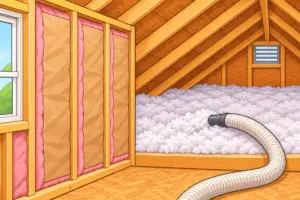
It depends on the material, the bag and the R-value you want. With the Owens Corning PINK fiberglass made for the AttiCat machine (27.5 lb bags), a 1,000 sq ft attic needs 19 bags for R-38 and 25 bags for R-49. With GreenFiber cellulose (30 lb bags) the same attic needs about 44 bags for R-38 and 61 for R-49, because cellulose is denser. Multiply by your attic area in thousands of square feet, and subtract what the old insulation already provides.
Every brand prints a coverage chart on the bag, and the numbers differ a lot, so always check the chart for the product you buy. The blown-in insulation calculator does the arithmetic with these two charts.
Bags per 1,000 square feet
| R-value | Fiberglass, 27.5 lb bags | Fiberglass depth | Cellulose, 30 lb bags | Cellulose depth, installed / settled |
|---|---|---|---|---|
| R-19 | 9 | 7 in | 18.8 | 5.7 / 5.3 in |
| R-30 | 15 | 10.75 in | 32.2 | 8.9 / 8.3 in |
| R-38 | 19 | 13.5 in | 43.9 | 11.2 / 10.4 in |
| R-49 | 25 | 17 in | 60.5 | 14.3 / 13.3 in |
| R-60 | 32 | 20.5 in | 77.1 | 17.3 / 16.1 in |
The charts list two numbers for a reason: you need both the minimum bags and the minimum depth to get the labeled R-value. Blowing the bags too fluffy reaches the depth with too little material; packing them too tight uses the bags before you reach the depth.
How to work it out
- Measure the attic floor: length × width of the area you will cover, in square feet.
- Find the bags per 1,000 sq ft for your target R-value on the bag chart.
- If there is insulation already, find the bags for its R-value and subtract.
- Bags = area ÷ 1,000 × (target bags − existing bags), rounded up.
Worked examples
Topping up with fiberglass. A 1,500 sq ft attic has about R-19 of old insulation and you want R-49. The chart gives 25 bags per 1,000 sq ft for R-49 and 9 for R-19, so you add 16 per 1,000 sq ft: 1.5 × 16 = 24 bags, blown about 10 in deeper.
An empty attic with cellulose. The same 1,500 sq ft attic with no insulation, filled to R-38 with cellulose: 1.5 × 43.9 = 65.9, so 66 bags, blown about 11.2 in deep so it settles to about 10.4 in.
Which R-value should you aim for?
The Department of Energy recommends R-30 to R-49 for an uninsulated attic in the warmest zone, R-49 to R-60 in zones 2 and 3, and R-60 in zones 4 to 8. Your local energy code may set its own minimum. Most attics already have some insulation, so measure its depth before you buy.
Before you blow
- Seal air leaks around pipes, wires, chimneys and light fixtures first; insulation does not stop air.
- Fit baffles at the eaves so soffit vents stay open, and keep insulation away from recessed lights not rated for contact.
- Staple depth rulers to joists across the attic so you can see when you have reached the target depth.
- Buy a few extra bags and return the unopened ones.
For walls and other open framing, batts are usually the simpler choice; see batts vs blown-in insulation.
Bags for common attic sizes
| Attic floor | Fiberglass R-38 | Fiberglass R-49 | Cellulose R-38 | Cellulose R-49 |
|---|---|---|---|---|
| 600 sq ft | 12 | 15 | 27 | 37 |
| 800 sq ft | 16 | 20 | 36 | 49 |
| 1,000 sq ft | 19 | 25 | 44 | 61 |
| 1,200 sq ft | 23 | 30 | 53 | 73 |
| 1,500 sq ft | 29 | 38 | 66 | 91 |
| 2,000 sq ft | 38 | 50 | 88 | 121 |
How much area one bag covers
| R-value | Fiberglass, per 27.5 lb bag | Cellulose, per 30 lb bag |
|---|---|---|
| R-30 | 67 sq ft | 31 sq ft |
| R-38 | 53 sq ft | 23 sq ft |
| R-49 | 40 sq ft | 17 sq ft |
Estimating the R-value already in your attic
Measure the depth of the old insulation in a few places and multiply by its R-value per inch. The Department of Energy gives roughly R-2.2 to R-2.7 per inch for loose-fill fiberglass, R-3.2 to R-3.8 for loose-fill cellulose and R-2.9 to R-3.8 for fiberglass batts. Six inches of old fiberglass batts is therefore about R-17 to R-23; use the R-19 row as a reasonable starting point. Old insulation that is compressed, wet or dirty performs below these figures.
Frequently asked questions
Does blown-in insulation settle?
Cellulose settles after it is blown, which is why its chart lists an installed depth and a lower settled depth; blow to the installed depth. The Owens Corning fiberglass chart gives the same figure for both.
Can I use fewer bags if I blow it thicker?
No. Each R-value needs both the minimum number of bags and the minimum depth. Fluffing the same bags to a greater depth spreads the material too thin to reach the labeled R-value.
What if my bags are a different brand?
Use the chart printed on your bag. Bag weights and coverage vary between brands, so the counts above apply only to the products named.
Sources
- Owens Corning AttiCat expanding blown-in insulation: application instructions and coverage chart (bags per 1,000 sq ft and thickness by R-value, 27.5 lb bag)
- GreenFiber INS506LD attic card (cellulose bags per 1,000 sq ft, installed and settled thickness, 30 lb bag)
- U.S. Department of Energy, Energy Saver: Insulation (recommended attic R-values by climate zone)
- U.S. Department of Energy, Energy Saver: Types of Insulation (where batts and loose-fill insulation are used)