A durable gravel driveway surface is usually placed 6 to 8 inches deep, loose, and compacted to about 4½ to 6 inches. That surface sits on a prepared, well-drained base; on soft or wet ground the base itself may need several more inches of larger stone. Shape the surface with a crown or side slope of ½ to ¾ inch per foot so water runs off instead of soaking in.
These depths come from Penn State’s Center for Dirt and Gravel Road Studies, which developed a surface aggregate specification for unpaved roads; the same principles apply to long private driveways. To turn the depth into material, use the gravel calculator.
What determines gravel driveway depth?
- The ground underneath. Firm, well-drained soil needs far less than clay or wet ground. Fix soft spots before adding surface gravel, or they will keep swallowing stone.
- Traffic. A single car is very different from delivery trucks, RVs or farm equipment.
- Drainage. Water is the main enemy of a gravel driveway. A crowned surface and ditches or swales at the sides matter as much as depth.
- Compaction. Loose gravel shrinks when compacted. The Penn State bulletin gives 8 inches loose compacting to 6, and 6 inches loose compacting to 4½.
Base layers vs surface gravel
| Layer | Purpose | Typical material |
|---|---|---|
| Subgrade | The native soil, cleared of topsoil and organic matter and shaped to drain | Existing soil |
| Base (where needed) | Bridges soft ground and carries the load | Larger crushed stone, sometimes over a geotextile |
| Surface | The driving layer; binds together and sheds water | Well-graded crushed stone with fines, compacted |
How to estimate cubic yards and tons
- Area. Length × width. A 12 × 60 ft driveway is 720 sq ft.
- Volume. Area × depth in feet ÷ 27. At 6 in: 720 × 0.5 ÷ 27 = 13.3 cubic yards.
- Allow for compaction. Add about 10%, giving 14.7 cubic yards.
- Convert to tons. Multiply by the weight per cubic yard your supplier gives. At a typical 2,800 lb per cubic yard: 14.7 × 1.4 = about 20.5 tons.
Weight per cubic yard depends on the stone, its gradation and moisture, so always ask the quarry. For the Penn State surface aggregate, the bulletin gives a quick tonnage rule: width × length × 0.04 for 8 inches loose (compacting to 6), or × 0.03 for 6 inches loose (compacting to 4½). For the 720 sq ft example that is 28.8 or 21.6 tons. That material is dense; lighter stone weighs less per yard.
Gravel needed per 100 feet of driveway
| Width | Depth | Cubic yards | With 10% extra | Tons (2,800 lb/yd³) |
|---|---|---|---|---|
| 10 ft | 4 in | 12.3 | 13.6 | 19 |
| 10 ft | 6 in | 18.5 | 20.4 | 28.5 |
| 10 ft | 8 in | 24.7 | 27.2 | 38 |
| 12 ft | 4 in | 14.8 | 16.3 | 22.8 |
| 12 ft | 6 in | 22.2 | 24.4 | 34.2 |
| 12 ft | 8 in | 29.6 | 32.6 | 45.6 |
A typical tri-axle dump truck carries a fixed number of tons, so round your order to full loads where that saves a delivery fee. The project material cost calculator adds up stone, delivery and any geotextile.
Gravel types for driveways
- Crushed stone with fines (often sold as crusher run, road base or similar local names) compacts into a firm surface.
- Clean crushed stone without fines drains freely and works as a base layer, but it stays loose on top.
- Pea gravel and river rock are rounded and decorative; they are poor driving surfaces because they shift under tires.
Product names vary by region, so describe the use to your supplier and ask what they recommend for a driveway surface and base.
Common drainage and compaction problems
- Potholes usually start where water sits. Restore the crown before adding stone.
- Ruts point to a soft base or a surface that was never compacted.
- Washboarding and loose stone come from rounded gravel or from a surface without enough fines to bind.
- Gravel migrating into the lawn is reduced with edging and a properly compacted surface.
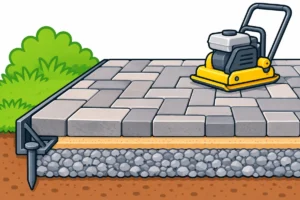
Paving instead? See how deep a paver base should be for driveway pavers.
Sources
- Penn State Center for Dirt and Gravel Road Studies: Driving Surface Aggregate Technical Bulletin (2025) (placement depth, compaction, crown and tonnage rule)