For small pours, bagged concrete is usually cheaper and simpler: there is no delivery fee and no minimum order. Once a job reaches about one cubic yard (around 50 bags of 80 lb), ready-mix delivered by truck usually costs less per yard and saves hours of mixing. Between roughly a third of a yard and one yard, the answer depends on your local prices, so the sections below show how to compare them with your own numbers.
Start with the volume. The concrete slab calculator gives cubic yards and bag counts for a slab, and the concrete bag calculator converts any volume into bags.
Bagged concrete vs ready-mix: key differences
| Bagged concrete | Ready-mix delivery | |
|---|---|---|
| How you buy it | By the bag at a store, picked up or delivered on a pallet | By the cubic yard from a local plant, delivered in a mixer truck |
| Smallest order | One bag | Often a minimum load; small loads may carry an extra fee |
| Mixing | By hand or in a rented mixer, one batch at a time | Arrives mixed and ready to place |
| Placing | Wheelbarrow, bucket or shovel | Truck chute, wheelbarrows, or a pump for hard-to-reach spots |
| Time pressure | Work at your own pace, batch by batch | The truck has to be unloaded promptly once it arrives |
| Best fit | Post holes, small pads, steps, repairs | Slabs, driveways, footings and anything over about a yard |
How many bags is a delivery-size pour?
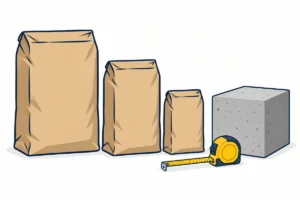
Using the standard yields from our concrete bag yield chart (0.60 cu ft per 80 lb bag) and 10% extra for waste:
| Volume | Cubic feet | 80 lb bags (with 10%) | Dry weight to handle |
|---|---|---|---|
| ¼ cubic yard | 6.75 | 13 | 1,040 lb |
| ½ cubic yard | 13.5 | 25 | 2,000 lb |
| 1 cubic yard | 27 | 50 | 4,000 lb |
| 2 cubic yards | 54 | 99 | 7,920 lb |
The weight column is the real reason people switch to ready-mix. Fifty bags is two tons of material to lift, carry, mix and place, in a short working window before the first batches start to set.
Cost per cubic yard: run your own numbers
Ready-mix prices vary a lot by region, season and mix design, and bag prices change from store to store, so we do not quote prices here. Instead, use this method with quotes from your own suppliers.
1. Cost of bags for one cubic yard
One cubic yard takes 45 bags of 80 lb, or about 50 with 10% extra. Multiply by the bag price:
| Price per 80 lb bag | 45 bags (no waste) | 50 bags (10% extra) |
|---|---|---|
| $5.00 | $225 | $250 |
| $6.00 | $270 | $300 |
| $7.00 | $315 | $350 |
| $8.00 | $360 | $400 |
2. Cost of ready-mix for the same job
Ask the plant for three numbers: the price per cubic yard for the mix you need, the minimum order, and any fee for loads below a full truck (often called a short-load or small-load fee). Add delivery or fuel charges if they are listed separately, and ask how long the driver can wait before extra time is billed.
3. Find the break-even volume
If ready-mix has fixed fees F and a price R per yard, and bags cost B per yard (including waste), the two options cost the same at:
Break-even volume = F ÷ (B − R)
Below that volume, bags are cheaper; above it, ready-mix is. For example, with made-up numbers to show the method: if bags cost $325 per yard, ready-mix is $170 per yard and the small-load fee is $120, the break-even is 120 ÷ (325 − 170) = 0.77 cubic yards. A half-yard pad would be cheaper with bags; a one-yard slab would be cheaper with a truck. The project material cost calculator is handy for adding up either option with tax and delivery.
Mixing time, labor and equipment
- Mixer size. QUIKRETE recommends allowing at least 1 cu ft of mixer capacity for each 80 lb bag, so a typical small rental drum handles one or two bags per batch.
- Crew. With bags, one person mixing and one placing keeps the work moving. With a truck, you need enough people and wheelbarrows to unload it promptly.
- Rental and extras. Add the mixer rental, a second wheelbarrow, and tools you do not own to the bagged side of the comparison.
- Cold joints. If a slab is poured in batches that start to set before the next one goes in, the seams can show and weaken the slab. Larger single pours are easier with ready-mix.
Delivery, access and minimum orders
- Check that a mixer truck can reach within chute distance of the forms, and that the ground and driveway can take its weight.
- If the truck cannot get close, ask about a concrete pump or a smaller delivery truck, and add that cost to the comparison.
- Order a little more than your calculated volume; running short with ready-mix means a second delivery and fees.
- Have the forms, base and reinforcement inspected and ready before the truck is booked.
Which option makes sense for your project?
| Project | Typical volume | Usually better |
|---|---|---|
| Setting fence or deck posts | A few bags per post | Bags |
| Small landing or step | Under ¼ yard | Bags |
| Shed pad or small patio | ½ to 1 yard | Compare both with real quotes |
| 10 × 10 ft slab, 4 in thick | About 1.4 yards with extra | Ready-mix |
| Driveway or large patio | Several yards | Ready-mix |
If you are still sizing the slab, read How Much Concrete Do I Need? for the volume formula and common slab sizes.
Sources
- QUIKRETE Concrete Mix (No. 1101) data sheet (bag yields and water per bag)