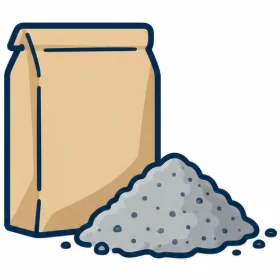
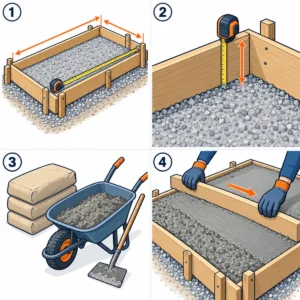
An 80 lb bag of standard pre-mixed concrete makes about 0.60 cubic feet of concrete, a 60 lb bag about 0.45 cu ft and a 40 lb bag about 0.30 cu ft. That works out to 45, 60 or 90 bags per cubic yard before you add anything for waste. The chart below gives the yield of each bag size in cubic feet, liters and square feet of coverage, followed by worked examples for small jobs.
If you already know your volume, the concrete bag calculator does the division for every bag size at once.
How much concrete does one bag make?
Bag yield is the volume of placed concrete you get after mixing one bag with the right amount of water. Each cubic foot of placed concrete takes about 133 lb of dry mix (80 ÷ 0.60), so the yield scales with the bag weight: double the weight, double the volume.
The figures in this guide come from the QUIKRETE Concrete Mix (No. 1101) data sheet, which lists approximately 0.30 ft³ for a 40 lb bag, 0.375 ft³ for 50 lb, 0.45 ft³ for 60 lb, 0.60 ft³ for 80 lb and 0.675 ft³ for the regional 90 lb bag. Other brands of standard concrete mix print very similar numbers, but fast-setting, high-strength and fiber-reinforced mixes can differ, so always check the yield printed on the bag you buy.
Concrete bag yield chart
| Bag size | Yield (cu ft) | Yield (liters) | Bags per cubic yard | Bags per cubic meter |
|---|---|---|---|---|
| 40 lb | 0.30 | 8.5 | 90 | 118 |
| 50 lb | 0.375 | 10.6 | 72 | 95 |
| 60 lb | 0.45 | 12.7 | 60 | 79 |
| 80 lb | 0.60 | 17.0 | 45 | 59 |
| 90 lb | 0.675 | 19.1 | 40 | 53 |
How many bags make one cubic yard?
A cubic yard is 27 cubic feet, so divide 27 by the yield of one bag:
- 80 lb bags: 27 ÷ 0.60 = 45 bags
- 60 lb bags: 27 ÷ 0.45 = 60 bags
- 40 lb bags: 27 ÷ 0.30 = 90 bags
With a 10% allowance for spills, uneven ground and forms that bow, that becomes 50, 66 and 99 bags. At around a cubic yard, 45 to 50 bags of 80 lb weigh 3,600 to 4,000 lb, which is the point where many people switch to ready-mix delivery.
How much area does one bag cover?
Coverage depends on how thick you pour. One bag covers its yield in cubic feet divided by the thickness in feet. For example, an 80 lb bag poured 4 in thick covers 0.60 ÷ (4 ÷ 12) = 1.8 square feet.
| Bag size | 2 in thick | 3 in thick | 4 in thick | 6 in thick |
|---|---|---|---|---|
| 40 lb | 1.8 sq ft | 1.2 sq ft | 0.9 sq ft | 0.6 sq ft |
| 60 lb | 2.7 sq ft | 1.8 sq ft | 1.35 sq ft | 0.9 sq ft |
| 80 lb | 3.6 sq ft | 2.4 sq ft | 1.8 sq ft | 1.2 sq ft |
Worked examples
A small landing: 3 × 4 ft, 4 in thick
Volume = 3 × 4 × (4 ÷ 12) = 4.0 cu ft. With 10% extra that is 4.4 cu ft. 4.4 ÷ 0.60 = 7.3, so buy 8 bags of 80 lb (or 10 bags of 60 lb, or 15 bags of 40 lb).
Setting one fence post
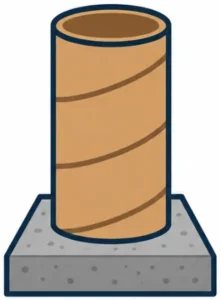
A 10 in round hole, 30 in deep, holds π × (5 ÷ 12)² × 2.5 = 1.36 cu ft. A 4×4 post (3.5 × 3.5 in actual) takes up 0.21 cu ft of that, leaving 1.15 cu ft of concrete. 1.15 ÷ 0.60 = 1.9, so plan on 2 bags of 80 lb per post. The fence post concrete calculator runs this for any hole size and number of posts.
A 10 × 10 ft patio slab, 4 in thick
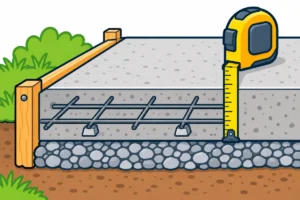
Volume = 10 × 10 × (4 ÷ 12) = 33.3 cu ft, or 1.23 cubic yards. With 10% extra that is 36.7 cu ft, which needs 62 bags of 80 lb, almost 5,000 lb of concrete to lift and mix by hand. For a slab this size, compare the cost of bags with a ready-mix delivery; see bagged concrete vs ready-mix. Our guide How Much Concrete Do I Need? covers the slab volume formula in more detail, and the concrete slab calculator handles the volume, waste and bag count together.
Common mistakes when estimating bagged concrete
- Confusing weight with volume. An 80 lb bag does not make 80 of anything. Work in cubic feet, then convert to bags.
- Forgetting to convert inches to feet. A 4 in slab is 0.333 ft thick, not 4 ft. This single slip makes the estimate 12 times too large.
- Skipping the waste allowance. Excavations are rarely perfectly flat and forms flex. 5 to 10% extra is common; buy a spare bag and return it unopened if you do not need it.
- Assuming every product yields the same. Specialty mixes can yield differently per pound. Use the number printed on the bag.
- Adding too much water to stretch the mix. Extra water does not create more concrete worth having; it weakens it. QUIKRETE lists about 6 to 9 pints of water per 80 lb bag of Concrete Mix.
Quick reference
- 1 cubic yard = 27 cubic feet = 0.765 cubic meters
- 1 cubic foot = 28.3 liters
- 80 lb bag ≈ 0.60 cu ft → 45 bags per cubic yard
- 60 lb bag ≈ 0.45 cu ft → 60 bags per cubic yard
- 40 lb bag ≈ 0.30 cu ft → 90 bags per cubic yard
Sources
- QUIKRETE Concrete Mix (No. 1101) data sheet (bag yields and water per bag)