Most wood fences have posts 8 feet apart, because rails come in 8 ft lengths; many builders drop to 6 feet for tall privacy fences or windy sites. Chain-link line posts are set no more than 10 feet apart. Vinyl and other panel fences follow the panel width. Corners, ends and gates always get their own posts, so count them separately from the even spacing along each straight run.
The fence calculator counts posts, rails, pickets and concrete from your fence length, post spacing and number of gates.
What determines fence post spacing?
- Material lengths. Wood rails are commonly sold in 8 ft lengths, which is why 8 ft spacing is the default for wood.
- Fence height and wind. A solid 6 ft privacy fence acts like a sail. Closer posts spread the wind load over more footings.
- Panel size. Vinyl, composite and metal panels are made to fixed widths, and the posts must match them.
- Ground and local rules. Soft soil, slopes and HOA or city rules can all push you toward closer spacing or specific designs.
Typical spacing by fence type
| Fence type | Typical post spacing | Why |
|---|---|---|
| Wood picket or privacy | 8 ft, or 6 ft for extra stiffness | Matches 8 ft rails; 6 ft reduces sag and wind load |
| Chain-link | Line posts no more than 10 ft apart | Keeps the mesh tight between terminal posts |
| Vinyl or other panels | Panel width plus the post | Measure center to center: panel width + post width + about ½ in |
| Woven or barbed wire (farm) | Line posts around 15 ft between braced terminals | Wire is stretched between braced ends |
How corners, gates and slopes affect the layout
- Corners and ends are terminal posts. They take the pull of the rails or mesh from one side and are usually larger or set deeper than line posts.
- Gates need a post on each side of the opening, sized for the gate’s weight. Measure the gate and hardware before setting them.
- Slopes. Measure spacing along the level, not along the ground. On a slope you either step the sections down or rack them to follow the grade; both need the posts placed to suit.
- Short leftover sections. If the last section of a run would be very short, spread the difference over the whole run so sections are even.
How to count posts and panels
For each straight run: sections = run length ÷ spacing, rounded up, and posts = sections + 1. Where runs meet at a corner, they share the corner post. Add one extra post for each gate.
| Fence length (one straight run) | 6 ft spacing | 8 ft spacing | 10 ft spacing |
|---|---|---|---|
| 50 ft | 10 posts | 8 posts | 6 posts |
| 100 ft | 18 posts | 14 posts | 11 posts |
| 150 ft | 26 posts | 20 posts | 16 posts |
| 200 ft | 35 posts | 26 posts | 21 posts |
Why corners add posts
A straight 100 ft run at 8 ft spacing needs 13 sections and 14 posts. Bend the same 100 ft into an L with two 50 ft sides and each side needs 7 sections (50 ÷ 8 = 6.25, rounded up). That is 7 + 7 + 1 = 15 posts, one more than the straight run, because each side rounds up on its own. A U-shaped yard with 50, 100 and 50 ft sides needs 7 + 13 + 7 + 1 = 28 posts. Count each side separately.
Common fence layout mistakes
- Measuring the total length once instead of each side, which undercounts posts at corners.
- Forgetting gate posts, or setting them for the post spacing instead of the actual gate width.
- Building right on the property line without checking where the line is. Get a survey if you are unsure.
- Not calling 811 before digging; buried utility lines are often within a few feet of fences.
- Ignoring height limits and setback rules from your city or HOA.
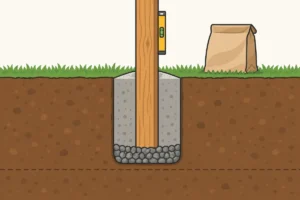
Once the posts are placed, the next question is how deep to set them; see fence post hole depth and the fence post concrete calculator.
Sources
- Hunker: Fence Post Spacing Guide (post spacing for wood, chain-link, wire and panel fences)